Ok. Wine procured (take notes, that word will come up again!)
Lesson 14: Qualitative Risk Analysis
How likely is it that your team will have to leap frog? How likely is it that you will have to split three legs across your van because your teammate has to drop due to job interview/angry spouse/broken leg?
Now is the time to figure out which identified risks (see last blog entry!) are likely to occur and how totally screwed you are if it does occur. Low on the P-I scale (probability impact) would be if a bee stings someone and they are uncomfortable on their run (i.e. I experienced my first bee sting ever in Great River and ran an uncomfortable several miles). High on the P-I scale would be that a major storm is destroying Chicago and your teammate's flight gets in the evening of the race.
Lesson 15: Quantitative Risk Analysis
Assign numbers to those qualitative risks. You can do this a few different ways.
1) Expected Monetary Value (EVM): multiply the value of each possible outcome by the probability of occurrence, then add them all together. i.e. Am I willing to spend an extra $100 to get extra insurance on our big white vans? (Value x Probability)
2) Sensitivity Analysis: How risk averse are you? I'll spend that extra $100 if I'm really worried about the vans
3) Decision Tree Analysis: Decision and the possible outcomes. If I don't get the insurance...I could save our team money, or be up shit creek and owning a couple grand to the insurance company if we get hit in the parking lot...
Lesson 16: Plan Risk Response
1) Develop options to enhance positive risks (opportunities): we're down a runner - if we find someone fast, we can potentially have less risk about getting to the finish line in time
2) Develop options to reduce negative risks (threats): Promise to check your email twice a day to prevent an angry boss
There are a few ways to deal with risks. This risk being an angry boss:
- Avoid it: Bring laptop and work through connectivity to best substitute that you're at the office
- Accept risk: Well. He'll be angry.
- Contingency Plan: If he's angry, I'll have my laptop and I can work through my phone.
- Transfer Risk: set up someone to work in your stead at the office
- Mitigate Risk: promise to work the day after Thanksgiving if you can take off this day
There are a few ways to deal with opportunities:
Exploit: I found a fast runner for our team. They now have the most miles!
Share: I found a fast runner for our team. Let's put them in the van that has the slowest combined time.
Enhance: I found a fast runner for our team. Let's give them short miles so they can run faster!
Lesson 17: Develop Human Resources Plan
Develop, document, assign project roles.
Remember that team google doc we had? Add a column in there that has a responsibility column. This will harken back to your WBS spreadsheet. If I were to get weird, I'd make an org chart here, but I'm not that weird, just yet. Once you add that column, that document actually becomes a "Responsibility Assignment Matrix" - or matching resources with tasks.
Yes, you are now in charge of ordering t-shirts. Yes, since you live closest to the start line, we are shipping our glowing stuff to your house.
Let's talk about different types of team structures.
Functional organizations: Project managers don't have a lot of authority - i.e. you just order the glowing stuff, you don't control how much is ordered or how the van is decorated
Matrix organizations: Project managers and execs share responsibility - i.e. the person in charge of decorating the van and the captain make the decisions together on how much to order and how to decorate
Projectized Organization: each project lead has authority over their area - i.e. There is a van decoration lead, a team t-shirt lead, etc.
In the real world, it's preferable to be a projectized organization. Don't do this for Ragnar. Your best bet is, honest to god, functional. At the most, have a very week matrix. This may also be my Type A talking.
Lesson 18: Plan Quality
What does good look like? While we're at it, let's talk about high-grade versus low-grade.
You can have a high or low grade team and still have high quality. High-grade is our vans - ridiculously complicated and seriously awesome. Low-grade are our cheering routines - I've seen teams with choreographed dances. That is seriously high-grade. We just scream and ring cowbells.
There are a bunch of ways to plan quality...cost-benefit analysis, statistical sampling, flow charting, all that. But frankly, the PMP exam doesn't spend enough time on this for me to care and I can't come up with a good analogy in Ragnar terms.
Lesson 19: Plan Communications
THIS IS THE MOST IMPORTANT THING EVER.
In cold, hard PMP language: communication provides the vital connections between people, concepts, and information through the project environment.
Time to determine:
1) What information is needed (how much does it costs to rent a van?)
2) When is it needed (3 months before - we need to rent those vans early and budget for them)
3) How will it be delivered (spreadsheet? email? phone call?)
Communication is a two-way street. My job as captain is NOT done if I send an email. I have to send an email and make sure that my team understands what I said in the email.
Keep in mind that there isn't just 1 two way street, no no, we have a lot of communication channels. That formula looks like this: N(N-1)/2. So, if there are 12 people on a team, that is 12(11)/2 = 66. That's a lot of channels.
Here are some communication types:
1) Informal Verbal: talking to prospective teammate during a race "hey *breath breath* I heard you want to run ragnar *breath*
2) Formal Verbal: team meeting (happening Dec. 1!)
3) Non-Verbal communications: All I will say is that I know when my teammates are in a bad mood
4) Informal Written: bantering emails
5) Formal Written: Invitation from Ragnar to join team
Lesson 20: Plan Procurements
Simply put: what do you need to buy? Here is your decision tree for what you need to acquire:
1) Make or buy - should I make posters of our team logo or have them made for me?
2) Select Procurement Documents - what kind of contracts do we need? Should I pay up front for the hotels or pay when we arrive?
3) Create procurement management plan - what does our cashflow look like?
4) Create the procurement SOW - how to submit expenses/get reimbursed and when to pull the trigger
5) Source selection - who should we pick to make our magnets?
For our team, we always go with Firm Fixed Price for our vans. We pay 1 flat fee, no extras (like per mile charge). A per mile charge would fall under a Time & Material contract. If you choose to have the rental company fill up the tank when you drop off the van - that's a cost reimbursable contract (avoid at all costs).
Lesson 21: Determine Budget
Add up all our of WBS cost estimations and then divide by 12. Does everyone cringe? Time to work on that budget again. I strongly suggest padding the budget by $50 a person. Gas is hella expensive.
There's a bit about s-curves in here, but all it means is that there's a line you shouldn't cross or that you shouldn't cross too soon (s-curve measures where you are in your project with how much money you've spent based on projections. If you're 50% done and should be through 40% of your budget, but you're already through 60% of your budget, send up the emergency flares)
Lesson 22: Develop Schedule
This is another important one and it seems to be the one that gets totally FUBAR if you model your team like a projectized organization. I swear by having a dictator.
One day, I will put our schedule into microsoft Project. Today, however, is not that day.
This is the best time to sit down and look at your critical path from when we worked on activities sequencing. Take into account the critical path (the minimum amount of days it takes to accomplish a task added up according to the sequence of activities).
If you find you're f'ed in the a, you have two options:
1) Crashing - assign more resources to the task (or pay rush shipping!)
2) Fast Tracking - have resources performed in parallel (decorate the vans while supporting runners)
Fun fact: Heuristic means "thumb rule" useless at Ragnar as it is probably not among Cards Against Humanity.
Lesson 23: Develop Project Management Plan
Put it alllllllll together.
This is your google docs (now called google drive, apparently. I won't tell you how many profanities I uttered while searching for "documents" on my gmail launch pad)
So. We've initiated, we've planned. Let's do this thing. On to Ragnaring the PMP Process - Executing
Friday, October 26, 2012


Thursday, October 25, 2012
Ragnaring the PMP Exam: Planning (Part 1)
You wonder why I start forming my teams at least 4 months in advance? In a formal project management setting, there are, wait for it, 20 steps in the planning phase. That' 48% of the project management official steps. FOURTY-EIGHT PERCENT.
Follow along, Ragnarians.
By now, you should have:
- Your first team email
- Team information google doc
In a vacuum, you get to do all the planning processes in a linear fashion. Yeah, no. The second that someone wants to fund my dream job in which all I do is organize Ragnar teams, theres a chance it could work like that, but in Ragnar life, it's just not going to happen. Trust me when I tell you, none of these planning phases are a one time bet. Open up your google docs, we're about to make some processes!
Lesson 4: Collect Requirements
The point of this phase is to understand all of your stakeholder's needs. For this step, we'll be talking about the team as a whole, instead of individuals. We'll take team needs and apply them to specific project objectives.
Example: Team Rated Ragnar wanted to be the Homecoming team at DC (I'm still a little sore we didn't win, can you tell?) To fulfill this business (read: team) objective, we had a few requirements:
- Best team name ever
- Most awesome glowing vans (ever)
- Seriously ridiculous glowing apparel (glowhawks!)
- Ragnar Spirit (red carpet treatment)
- Mascot (RAGBEAR!)
Lesson 5: Define Scope
This is your second team email. It's much like your first email to the team, but now, everyone has paid up and you have an official team. Let's make the wall of truth for realz.
The point of a scope statement is to make sure everyone is on the same page and when, months from now, it's 2 weeks to the race and someone says "I didn't know" you can say "yes, you damn well did." Maybe not in those words. Mywall of truth scope looks like this:
- I understand the general way that Ragnar works
- I will be ready to go at 2pm on Thursday; no, this does not mean that my plane gets in at 2pm
- I will not make plans for Saturday night
- I will not pressure my teammates to make time goals - we are here for a fun time, not a fast time
- I will be grateful to all staff and volunteers on course (and say thank you!)
- I will follow all race rules (ESPECIALLY NIGHT SAFETY OR I RISK CAPTAIN NIGERIA STAPLING MY SAFETY VEST TO MY BACK)
- I will respond to emails from my captain
- If I cannot make the race, I am responsible for my replacement and cannot be refunded my entry fee
That scope/email does the following:
- Provides a description (This is what our team is going to accomplish)
- Provides acceptance criteria (when we're at the start line, what needs to be done)
- Project exclusions (what we aren't going to do: namely...win)
- Project constraints (i.e. budget and schedule)
- Project assumptions (what every team member is assuming they will be able to do, and what happens if they can't...i.e. show up to the race)
Lesson 6: Create the WBS
Think of the WBS (work breakdown structure) as that massive, step-by-step checklist to get you from registration to standing at the finish line, drinking beer. Anything that isn't on this list is a "would be nice, but not crucial" item. For Team Rated Ragnar, glowing vans are a crucial item. Procurement of glowing items is on my "WBS."
Make another google doc with the following categories:
- Task
- Person responsible
- Due date (this is cheating - WBS don't have time frames)
Your WBS should go down to the level of detail where it's actionable and not able to be further subdivided. Let's take glowing vans:
1) Decorated Van
1a) Determine Van Theme (glow)
1b) Determine How to Accomplish Theme (lots of glowing stuff)
1c) Order lots of glowing stuff (glowuniverse.com)
1d) Acquire Decorating supplies (tape, contact paper, scissors)
1e) Decorate van
That process is called decomposition. Also known as what happens to your brain when you try to do it by yourself. Instead: decompose the major tasks into small tasks and give to your teammates.
Important note, though there isn't a time frame in your WBS, your work packages (i.e. "Decorate Van") should be:
- Scheduled
- Cost estimated
- Monitored
- Controlled
Lesson 7: Define Activities
While the WBS is defined by deliverables (decorate van!), what happens in that task list I started up there is actually called defining activities. More decomposition! This is bullocks because I don't need to give my teammates a step by step list on how to order stuff on line. This may come in handy when designing a shirt though. That's tougher than it seems.
One theory is the "rolling wave" theory - which I used for my first team - it was basically defining my activities as they came, in small chunks, then worrying about other stuff in the future. I'm shocked my team survived my first Ragnar.
Lesson 8: Estimate Activity Resources
What do you need to make that list above happen? This one is too self explanatory, but PMPers have made this ridiculously intricate. I do a lot of budgeting in this phase. I recommend bottom-up estimating (assign time/money to each activity, then add it all up)
The real world calls this an Resource Breakdown Structure. I call it "the first Ragnar heart attack."
Lesson 9: Sequence Activities
It seems like this would make sense, and that it would all come intuitively, but it doesn't. Remember these key words: 11 other people, 200 miles, 2 vans, 30+ hours. There is NO intuition in that. While you are months out, make this list for yourself. It will look stupid, but trust me, it isn't. For example:
1) Confirm someone wants to be on team
2) Get paid via PayPal
3) Send Ragnar Team invite through Ragnar
4) Send access to Google Doc
5) Confirm that teammate has signed waiver
6) Confirm teammate has put in appropriate pace estimation
7) Confirm teammate has filled out info on google doc
Seriously. You'll find yourself weeks later, trying to make sure they paid or figure out why their invite isn't working.
If I could make a process flow, I would. Maybe I will and publish it later. But let's talk about process flows (Project Network Logic Diagram if we're being official) while we're at it. There are 4 types of interactivity relationships.
Once you've built this, take the longest route from start to finish and that is your "critical path" - this is the shortest amount of time that it takes to get through your project. I know that's odd, but work with me here.
You can build this chart two ways:
- Arrow diagramming method (ADM) also called Activity on Arrow
- Precedence Diagramming method (PDM)
ADM only show Finish to Start interdependencies while PDM shows all four.
- Finish to Start - You can't invite people to the team until you've registered
- Start to Finish - This one is tricky, but think about it like this: I can start sending out "you owe x for x" emails once shirts have been ordered. I never do this, but it's the best example I have.
- Finish to Finish - I won't send a bill to the entire team (finishing finances) until I've received all of the expenses from everyone
- Start to Start - We can start decorating the van when the sun starts to set
Leads and Lags:
- Leads show the time saved when you can overlap tasks: i.e. for "fun stuff" completion, I can order glowing stuff and t-shirts at the same time. Instead of each taking 3 days to ship back to back, they will ship at the same time, thus saving 3 days.
- Lags show waiting time. If the team doesn't pay me until 2 weeks after the race, I can't repay people's expenses until I have that money.
Think about it in terms of Ragnar Showers:
If there are only three stalls at the high school, you cannot have more than 3 people showering at once (well, you could, but we're not going there). If you have a prison shower situation, you can have multiple people showering at once (let's go with 9), there you go - lead time.
Major Exchanges:
Force the group to do group activities right when you get to major exchanges (night decorations, photos, etc.) instead of dispersing. When the group disperses, you immediately introduce lag time because you fracture dependent activities into F-S activities. Yes? Yes.
Slack:
This is the latest finish time minus the earliest finish time. Here's my best example. You saw your runner at the halfway point in their leg. At the fastest they can go, they'll be at the exchange in 30 minutes. At the slowest, it'll take them 50 minutes. Your slack time (to go pee at the nearest gas station) is 20 minutes.
Lesson 10: Estimate Activity Duration
All you need to know is that it's better to have a range of times for expecting your runner, rather than a set point. No one runs precise 9 minute miles on 0 sleep. No one.
Let's calculate a 3 point estimate on a runner's time. Best case, runner 1 will do their leg in 28 minutes. Most probable is 33, but if there's a mountain in there, it'll take 40 minutes. Our formula is this: (40+4*33+28)/6 = 33.3 minutes. I haven't gotten this anal yet, don't worry.
Moving on.
Lesson 11: Estimate Costs
This is the most important thing EVER. Seriously. I'm spending the most amount of time in my off season working on this process for my team.
The final bill for Ragnar has direct and indirect costs. Direct costs = the cost of glowing shit Indirect = we don't really have these. But if we had a secretary that we were paying to organize all this, her salary would be indirect.
I use analogous estimating the most for this (historical costs). Parametric estimating is also a good bet - this is historical costs (vans cost 400 bucks a piece in 2010) plus other variables (but now taxes have gone up, so I bet it's closer to 415).
Lesson 12: Plan Risk Management
MY TEAM IS PERFECT TRA-LA-LA NOTHING WILL GO WRONG. You're an idiot. My team is perfect and shit goes wrong ALL the time. Wait, I'm sorry, your plane is HOW MANY HOURS DELAYED? Hold on...the shirts didn't ship? What do you mean our volunteer has the stomach flu? Hold up. I have to do an ULTRA because you have a job interview??
Fortunately, risks can be positive and negative. We just generally call them negative. Good risks are surprise fun things. Like...hey! I get to do an ultra because our team member had to drop out at the last minute! (Or is that the mental illness talking?)
Here is your process:
- Figure out what risks might happen (your teammate gets a job interview and can't make the trip)
- Characteristics (you are now at 11 people on a team)
- Indicators that the risk has occurred (you, as captain, are running 34 miles instead of 20)
Seriously, though. I use this system all the time to determine if we need to begin leap frogging our runners/vans so we can get to the finish line in time.
Lesson 13: Identify Risks
Determine what is likely to happen (my team will need to leap frog) and what that looks like (we're getting dangerously close to finishing after the finish line shuts down).
You can chart this stuff out, but I don't have time for that on the road and usually, I can't even find a pen by leg 20. Regardless, here are some risk types:
Kinds of Risk!
- Technical (our van breaks down)
- Project management (our captain is an idiot and didn't get insurance on the vans)
- Organization (two people broke up right before the race and are now stuck in a van together for 30 hours)
- External (it's pouring and our van is stuck in mud)
Not kidding, I have witnessed these things happen (thank god, not on my team). Risky business, this Ragnar stuff!
Ok. Wine break. We'll finish up Ragnaring the PMP Process: Planning Part 2 next.
Follow along, Ragnarians.
By now, you should have:
- Your first team email
- Team information google doc
In a vacuum, you get to do all the planning processes in a linear fashion. Yeah, no. The second that someone wants to fund my dream job in which all I do is organize Ragnar teams, theres a chance it could work like that, but in Ragnar life, it's just not going to happen. Trust me when I tell you, none of these planning phases are a one time bet. Open up your google docs, we're about to make some processes!
Lesson 4: Collect Requirements
The point of this phase is to understand all of your stakeholder's needs. For this step, we'll be talking about the team as a whole, instead of individuals. We'll take team needs and apply them to specific project objectives.
Example: Team Rated Ragnar wanted to be the Homecoming team at DC (I'm still a little sore we didn't win, can you tell?) To fulfill this business (read: team) objective, we had a few requirements:
- Best team name ever
- Most awesome glowing vans (ever)
- Seriously ridiculous glowing apparel (glowhawks!)
- Ragnar Spirit (red carpet treatment)
- Mascot (RAGBEAR!)
Lesson 5: Define Scope
This is your second team email. It's much like your first email to the team, but now, everyone has paid up and you have an official team. Let's make the wall of truth for realz.
The point of a scope statement is to make sure everyone is on the same page and when, months from now, it's 2 weeks to the race and someone says "I didn't know" you can say "yes, you damn well did." Maybe not in those words. My
- I understand the general way that Ragnar works
- I will be ready to go at 2pm on Thursday; no, this does not mean that my plane gets in at 2pm
- I will not make plans for Saturday night
- I will not pressure my teammates to make time goals - we are here for a fun time, not a fast time
- I will be grateful to all staff and volunteers on course (and say thank you!)
- I will follow all race rules (ESPECIALLY NIGHT SAFETY OR I RISK CAPTAIN NIGERIA STAPLING MY SAFETY VEST TO MY BACK)
- I will respond to emails from my captain
- If I cannot make the race, I am responsible for my replacement and cannot be refunded my entry fee
That scope/email does the following:
- Provides a description (This is what our team is going to accomplish)
- Provides acceptance criteria (when we're at the start line, what needs to be done)
- Project exclusions (what we aren't going to do: namely...win)
- Project constraints (i.e. budget and schedule)
- Project assumptions (what every team member is assuming they will be able to do, and what happens if they can't...i.e. show up to the race)
Lesson 6: Create the WBS
Think of the WBS (work breakdown structure) as that massive, step-by-step checklist to get you from registration to standing at the finish line, drinking beer. Anything that isn't on this list is a "would be nice, but not crucial" item. For Team Rated Ragnar, glowing vans are a crucial item. Procurement of glowing items is on my "WBS."
Make another google doc with the following categories:
- Task
- Person responsible
- Due date (this is cheating - WBS don't have time frames)
Your WBS should go down to the level of detail where it's actionable and not able to be further subdivided. Let's take glowing vans:
1) Decorated Van
1a) Determine Van Theme (glow)
1b) Determine How to Accomplish Theme (lots of glowing stuff)
1c) Order lots of glowing stuff (glowuniverse.com)
1d) Acquire Decorating supplies (tape, contact paper, scissors)
1e) Decorate van
That process is called decomposition. Also known as what happens to your brain when you try to do it by yourself. Instead: decompose the major tasks into small tasks and give to your teammates.
Important note, though there isn't a time frame in your WBS, your work packages (i.e. "Decorate Van") should be:
- Scheduled
- Cost estimated
- Monitored
- Controlled
Lesson 7: Define Activities
While the WBS is defined by deliverables (decorate van!), what happens in that task list I started up there is actually called defining activities. More decomposition! This is bullocks because I don't need to give my teammates a step by step list on how to order stuff on line. This may come in handy when designing a shirt though. That's tougher than it seems.
One theory is the "rolling wave" theory - which I used for my first team - it was basically defining my activities as they came, in small chunks, then worrying about other stuff in the future. I'm shocked my team survived my first Ragnar.
Lesson 8: Estimate Activity Resources
What do you need to make that list above happen? This one is too self explanatory, but PMPers have made this ridiculously intricate. I do a lot of budgeting in this phase. I recommend bottom-up estimating (assign time/money to each activity, then add it all up)
The real world calls this an Resource Breakdown Structure. I call it "the first Ragnar heart attack."
Lesson 9: Sequence Activities
It seems like this would make sense, and that it would all come intuitively, but it doesn't. Remember these key words: 11 other people, 200 miles, 2 vans, 30+ hours. There is NO intuition in that. While you are months out, make this list for yourself. It will look stupid, but trust me, it isn't. For example:
1) Confirm someone wants to be on team
2) Get paid via PayPal
3) Send Ragnar Team invite through Ragnar
4) Send access to Google Doc
5) Confirm that teammate has signed waiver
6) Confirm teammate has put in appropriate pace estimation
7) Confirm teammate has filled out info on google doc
Seriously. You'll find yourself weeks later, trying to make sure they paid or figure out why their invite isn't working.
If I could make a process flow, I would. Maybe I will and publish it later. But let's talk about process flows (Project Network Logic Diagram if we're being official) while we're at it. There are 4 types of interactivity relationships.
Once you've built this, take the longest route from start to finish and that is your "critical path" - this is the shortest amount of time that it takes to get through your project. I know that's odd, but work with me here.
You can build this chart two ways:
- Arrow diagramming method (ADM) also called Activity on Arrow
- Precedence Diagramming method (PDM)
ADM only show Finish to Start interdependencies while PDM shows all four.
- Finish to Start - You can't invite people to the team until you've registered
- Start to Finish - This one is tricky, but think about it like this: I can start sending out "you owe x for x" emails once shirts have been ordered. I never do this, but it's the best example I have.
- Finish to Finish - I won't send a bill to the entire team (finishing finances) until I've received all of the expenses from everyone
- Start to Start - We can start decorating the van when the sun starts to set
Leads and Lags:
- Leads show the time saved when you can overlap tasks: i.e. for "fun stuff" completion, I can order glowing stuff and t-shirts at the same time. Instead of each taking 3 days to ship back to back, they will ship at the same time, thus saving 3 days.
- Lags show waiting time. If the team doesn't pay me until 2 weeks after the race, I can't repay people's expenses until I have that money.
Think about it in terms of Ragnar Showers:
If there are only three stalls at the high school, you cannot have more than 3 people showering at once (well, you could, but we're not going there). If you have a prison shower situation, you can have multiple people showering at once (let's go with 9), there you go - lead time.
Major Exchanges:
Force the group to do group activities right when you get to major exchanges (night decorations, photos, etc.) instead of dispersing. When the group disperses, you immediately introduce lag time because you fracture dependent activities into F-S activities. Yes? Yes.
Slack:
This is the latest finish time minus the earliest finish time. Here's my best example. You saw your runner at the halfway point in their leg. At the fastest they can go, they'll be at the exchange in 30 minutes. At the slowest, it'll take them 50 minutes. Your slack time (to go pee at the nearest gas station) is 20 minutes.
Lesson 10: Estimate Activity Duration
All you need to know is that it's better to have a range of times for expecting your runner, rather than a set point. No one runs precise 9 minute miles on 0 sleep. No one.
Let's calculate a 3 point estimate on a runner's time. Best case, runner 1 will do their leg in 28 minutes. Most probable is 33, but if there's a mountain in there, it'll take 40 minutes. Our formula is this: (40+4*33+28)/6 = 33.3 minutes. I haven't gotten this anal yet, don't worry.
Moving on.
Lesson 11: Estimate Costs
This is the most important thing EVER. Seriously. I'm spending the most amount of time in my off season working on this process for my team.
The final bill for Ragnar has direct and indirect costs. Direct costs = the cost of glowing shit Indirect = we don't really have these. But if we had a secretary that we were paying to organize all this, her salary would be indirect.
I use analogous estimating the most for this (historical costs). Parametric estimating is also a good bet - this is historical costs (vans cost 400 bucks a piece in 2010) plus other variables (but now taxes have gone up, so I bet it's closer to 415).
Lesson 12: Plan Risk Management
MY TEAM IS PERFECT TRA-LA-LA NOTHING WILL GO WRONG. You're an idiot. My team is perfect and shit goes wrong ALL the time. Wait, I'm sorry, your plane is HOW MANY HOURS DELAYED? Hold on...the shirts didn't ship? What do you mean our volunteer has the stomach flu? Hold up. I have to do an ULTRA because you have a job interview??
Fortunately, risks can be positive and negative. We just generally call them negative. Good risks are surprise fun things. Like...hey! I get to do an ultra because our team member had to drop out at the last minute! (Or is that the mental illness talking?)
Here is your process:
- Figure out what risks might happen (your teammate gets a job interview and can't make the trip)
- Characteristics (you are now at 11 people on a team)
- Indicators that the risk has occurred (you, as captain, are running 34 miles instead of 20)
Seriously, though. I use this system all the time to determine if we need to begin leap frogging our runners/vans so we can get to the finish line in time.
Lesson 13: Identify Risks
Determine what is likely to happen (my team will need to leap frog) and what that looks like (we're getting dangerously close to finishing after the finish line shuts down).
You can chart this stuff out, but I don't have time for that on the road and usually, I can't even find a pen by leg 20. Regardless, here are some risk types:
Kinds of Risk!
- Technical (our van breaks down)
- Project management (our captain is an idiot and didn't get insurance on the vans)
- Organization (two people broke up right before the race and are now stuck in a van together for 30 hours)
- External (it's pouring and our van is stuck in mud)
Not kidding, I have witnessed these things happen (thank god, not on my team). Risky business, this Ragnar stuff!
Ok. Wine break. We'll finish up Ragnaring the PMP Process: Planning Part 2 next.
Ragnaring the PMP Exam: Initiating
Tonight, I am breaking my blogging avoidance (hi! I lived through the 70.3!) by studying for my PMP (project management professional) and applying it to captaining a Ragnar team!
So, all you current or future PMPs out there, you can totally captain a Ragnar team. Ragnar Captains - you can totally pass a PMP Exam!
Let's begin. You will find PMP concepts in black, Ragnar concepts in orange.
Lesson 1: Mastering the PMBOK (How to Captain a Team)
A project is a temporary endeavor undertaken to create a unique product, service or result. It has a beginning and an end. Captaining a team for one race!
A stakeholder is anyone or group actively involved in a project. Teammates, race officials, volunteers.
The PMBOK guide identifies best practices, etc. Hello, this is your Ragnar Race Bible.
The level of the project management effort should be proportional to the size/scope of the project. Don't spend 10k and 6 months of full time planning on your team. Also: don't spend $10 and put it together in a week.
Initiating and Planning are the most important phases. Don't show up to a race (executing!) without proper planning. Bad bad bad things happen when you do that.
Lesson 2: Develop Project Charter Process
A formal project charter documents:
1) Preliminary characteristics of the project (team name! race date! race location!)
2) Authorizes the project (confirms team registration)
3) Identifies the project manager (team captain)
Your project charter is your first email to the team. It's a high level email with the preliminary, high level points of your team and race expectations. This is your wall of truth (you MUST be ready to go at 2pm on Thursday - do NOT make Saturday afternoon plans.) Now is the time to tell your team you expect a 7 minute mile. It shouldn't be too long - if you have to scroll too long on your phone to read the email, make it shorter.
Lesson 3: Identify the Stakeholders Process
Now is the time to identify your stakeholders: teammates, your volunteers (if you're within 100 miles of the course), the race director, and anyone else involved - yes, this includes spouses (the good and bad kind).
Analyze each of your teammate's roles, interest, knowledge, expectation and influence.
For example:
Creative Person who has never done Ragnar, but has high expectations because they've been wanting to do Ragnar for years. They're bringing two other people to the team.
Role: Team designer! Make the shirts!
Interest: High
Knowledge: Low
Expectation: Figure this out fast - good time? Fast time? Something else?
Influence: High - you have a fourth of the team riding in their sphere of influence
Classify your stakeholders by level of authority, concern, involvement, and ability to affect change, salience, need for immediate attention, etc. Trust me. I've made the mistake of not doing this and it was disastrous. 11 other people is a LOT of cat herding.
In the PMP world, you'd make a Stakeholder register and a stakeholder management strategy. In Ragnar world - make a google doc with everyone's info and take the time to talk to each of your teammates individually about the above.
Next up, we have the PLANNING Process Group!
So, all you current or future PMPs out there, you can totally captain a Ragnar team. Ragnar Captains - you can totally pass a PMP Exam!
Let's begin. You will find PMP concepts in black, Ragnar concepts in orange.
Lesson 1: Mastering the PMBOK (How to Captain a Team)
A project is a temporary endeavor undertaken to create a unique product, service or result. It has a beginning and an end. Captaining a team for one race!
A stakeholder is anyone or group actively involved in a project. Teammates, race officials, volunteers.
The PMBOK guide identifies best practices, etc. Hello, this is your Ragnar Race Bible.
The level of the project management effort should be proportional to the size/scope of the project. Don't spend 10k and 6 months of full time planning on your team. Also: don't spend $10 and put it together in a week.
Initiating and Planning are the most important phases. Don't show up to a race (executing!) without proper planning. Bad bad bad things happen when you do that.
Lesson 2: Develop Project Charter Process
A formal project charter documents:
1) Preliminary characteristics of the project (team name! race date! race location!)
2) Authorizes the project (confirms team registration)
3) Identifies the project manager (team captain)
Your project charter is your first email to the team. It's a high level email with the preliminary, high level points of your team and race expectations. This is your wall of truth (you MUST be ready to go at 2pm on Thursday - do NOT make Saturday afternoon plans.) Now is the time to tell your team you expect a 7 minute mile. It shouldn't be too long - if you have to scroll too long on your phone to read the email, make it shorter.
Lesson 3: Identify the Stakeholders Process
Now is the time to identify your stakeholders: teammates, your volunteers (if you're within 100 miles of the course), the race director, and anyone else involved - yes, this includes spouses (the good and bad kind).
Analyze each of your teammate's roles, interest, knowledge, expectation and influence.
For example:
Creative Person who has never done Ragnar, but has high expectations because they've been wanting to do Ragnar for years. They're bringing two other people to the team.
Role: Team designer! Make the shirts!
Interest: High
Knowledge: Low
Expectation: Figure this out fast - good time? Fast time? Something else?
Influence: High - you have a fourth of the team riding in their sphere of influence
Classify your stakeholders by level of authority, concern, involvement, and ability to affect change, salience, need for immediate attention, etc. Trust me. I've made the mistake of not doing this and it was disastrous. 11 other people is a LOT of cat herding.
In the PMP world, you'd make a Stakeholder register and a stakeholder management strategy. In Ragnar world - make a google doc with everyone's info and take the time to talk to each of your teammates individually about the above.
Next up, we have the PLANNING Process Group!
Tuesday, July 10, 2012
The Blue Terror
As many of you know, I am terrified of my bike.
The blue terror has earned its name pretty well. I bought the bike from a nice guy and his wife on Craigslist. I know, I know, I heard the lectures about buying a bike from some place other than a shop, but y'all, there was just no way I was going to afford a half IM worthy bike from a store. Even used.
I stalked Craigslist for a couple days, asked around about a couple bikes, but nothing was just right. I'd already gone down to a bike shop with the help of Blair, and learned roughly what I needed.
The post came up, a 52cm women's road bike. Hardly used. Upgraded brakes. Turns out the guy selling it bought it for his wife, she took it out for the first time clipped in...and then promptly ate it (as everyone does when they go clipless). She took the hit so hard that she bent the right side of the handle bar. Shortly thereafter, she got pregnant. You can imagine how the conversation went regarding the bike. Original owner: 0, Blue Terror: 1.
So, I took it for a ride and, knowing precisely 0 about bikes, bought it.
Second owner: 0, Blue Terror: 2
The first time I clipped in, I actually did not fall. I will admit that it was a terrifying day of being about 2-3 minutes behind my team at all times, and every time I had to clip out, I had a mild panic attack and jumped off my bike. Yup. You read that right. Jumped off of it.
I didn't fall that ride. Instead, my legs gave out while I was getting off my bike and talking to my coach and THEN I ate it.
Mia: 0, Blue Terror: 3
The next time I went out with my team, we were near traffic. This was a HUGE mental block for me. I'm really careful to notice bikes, but what about other people out enjoying their Saturdays? Fat chance. We actually did fairly well until a cop pulled over part of our team to scold us for slowing instead of stopping at a stop sign with no other traffic. She had the nerve to tell us that we were the reason motorists hated cyclists...
Honey, have you worked in Dupont?
Regardless, I was catching up with my team and went to stop, but left too much weight on my clipped foot and just went right over. It does feel just like slow motion. I left bloody palm prints on my handle bars that morning.
Mia: 0, Blue Terror: 4
When I got back from my group ride, my coach made me practice clipping in and out over and over and over again. I had a total freak out. God bless my coach she pulled a total parent move on me. I know that tone of voice. She held my bike upright and made me practice in out in out in out. I was shaking and she said "Calm down. You can do this." And she's right...I could! Tentative victory!
Then I had to clip in and ride a little in the grass, unclip and get off and do it again. I fell the second time. Ouch, but less painful on grass versus pavement. Slightly more tentative victory!
Thus was the pattern for several weeks.
And then, one miraculous morning, I got up, got my bike on the car and drove to Haines Point. The gates were still closed, so after I wobbled off, clipped in, I had to jump a small curb (ACK) and make a quick wiggle around a post (AAAHHHHH) and go back down a curb (UGCK). This started out nicely enough
Mia - .5, Blue Terror: 4
Somewhere around my second lap, my legs were crapping out. Everyone else looked like they were sailing past me. Well, not looked like...they WERE. So, I stopped, put air in my tires*, and continued. No dice. 12 miles ish in an hour.
(* wait for it...wait for it...scroll down...)
Two weeks ago, I go out for my first big brick workout. I am SO excited. I go for my 10 mile run, come back, all excited about a 30 mile bike. My plan was to do two out and backs on the Capital Crescent. 7 miles out, kids were passing me on bmx bikes. No joke.
I stopped, almost threw my bike over the trees and texted Alicia:
"Chadd doesn't have his phone, so I'm telling you this. I'm on the Capital Crescent Path, I'm about 7 miles into 30 and I feel like total shit. If I don't text you by noon, please call me."To the credit of the amazing Alicia, she offered to come pick me up.
I made my first 15 mile loop, swearing, huffing, puffing, and all but ready to give up. I rolled up to Coach and told her that I was going abysmally slow. Even for someone who just ran 10 miles. I had this mental image of being the last swimmer out of the water at Patriots and then having the sag wagon pick me and the Blue Terror up at mile 15 on the bike.
She squeezed my back tire.
"*That's flat."
"Oh."
Mia - 0, Blue Terror: 5 (See below on my critical mistake on how to inflate your tires)
Tire pumped, legs still on fire from my accidental 15 mile slog, Coach sent me back out for 5 miles, to Haines Point and back. Huzzah! I'm flying! Garmin is reading 17-19 miles an hour. WOOHOOO.
Annnnnd that was the last time I got out on the bike due to heat, fear of traffic, or that one time when I ate it on the pavement a mile into my run on my brick workout and had to call it a day.
The Blue Terror and I did sit on the demon trainer from hell yesterday and managed to put a nice black mark on the carpet (redecorating, the triathlete way!) but for now, we have a tentative agreement. If we stay off the demon trainer and keep air in the tires, we'll both be a lot happier.
.JPG)
Me and the Blue Terror
(:12 make sure you unscrew the valves!)
Friday, June 29, 2012
Ragnar 101
I recently wrote an email to my Ragnar New York Team about Ragnar and with a bunch of people asking me more and more about it (and why I love it) I figured I'd post the letter here, modified for general Ragnar.
The Basics
Each Ragnar is a point-to-point race of roughly 200 miles. Teams can be comprised of either 6 runners (ultra) or 12 (regular). Most teams run as a regular team.
Van 1 will have runners 1-6 and Van 2 will have runners 7-12. Both vans will meet at the start line where Van 1 will check in. Different teams start at different times, based on their estimated pace. My team usually has an early start time so we can take our time and enjoy ourselves down the course. People who take this race seriously (few and far between) tend to have start times later in the day.
After runner 1 starts, Van 1 will drive to exchange 1 and wait for runner 1/drop off runner 2 and move along to exchange 2. Rinse and repeat through runner 6. While someone in your van is running, the van stops to support that runner, as long as it's allowed. Most legs allow for support - Ragnar will list the leg as "non-support" if vans cannot access the runner, or if it's unsafe for vans to pull over. Support means either stopping to give them water, food, gatorade, or just cheer and wave frantically while they run by. Ragnar even gives you nifty orange safety flags which make for excellent interpretive dancing.
While Van 1 is running, Van 2 drives from the start line to Major Exchange 6 where they will check in and wait for Van 1's runners to finish. Major Exchanges are the only places were both vans are allowed into the parking lot. These major exchanges are 6, 12, 18, 24, 30, and obviously the finish line.
Each van will be "running" 3 times - so everyone runs 3 legs. It's important to know, too, that if you are runner 4, you have to run legs 4, 16 and 28 (you can't pick and choose singular legs).
The Running
Ragnar is largely on paved roads, so you don't need to worry about very technical trail running. Occasionally, runners will be on gravel roads and very rarely on trails. In the five I've done, I have yet to see a trail that was so difficult that I'd suggest wearing anything but basic running clothes/shoes.
A note on difficulty: the Ragnar "difficult" descriptions are slightly misleading. They're done largely by distance. Look at the map for the elevation chart to get a better picture of how difficult the leg will actually be.
Running/walking/skipping/
If you are picky about what you wear while running, I'd suggest getting used to wearing a reflective vest, a tail light (red LED) and a headlamp (or carrying a flashlight). These items are required by Ragnar during night hours (which are usually around 7-7, pending time of the year). If you are not in safety gear while running, the team is given one "strike." Three strikes - you're asked to leave the course. If you are NOT running during night hours, you are still required to wear a reflective vest. Tired people driving huge vans in the middle of the night + non reflective person = bad. Tip on the headlamp: wear it over a hat. Petzel sells pretty good ones for about $20 and it's always nice to have your own headlamp unless you like sharing sweaty headbands.
The Not Running
But what in the world do I do while my van is NOT running? First of all, probably eating. You'll eat a lot, though I advise against 3 sloppy joes (apparently outside of the south, these are called steamers?) and ice cream at the same time (now would be the time for an emoticon that barfs). There will also be some hanging out, talking with other teams, taking pictures, and sleeping. Sometimes a major exchange will have showers so you can be clean for at least a couple minutes. Major exchanges tend to be at high schools, churches, YMCAs, or other community based locations. These places go out of their way to be hospitable and often times sell food as fundraisers. Interacting with the local community is such a great part of Ragnar that I promise you won't be bored while you're hanging out and waiting for the other van.
The Creative Stuff
Ragnar encourages letting your [creative] juices flow. Team names are usually hilarious (there was a team in California of Indian guys who called their team "Curry in a Hurry"), inappropriate (DC has the "Sofa Kings"), or both...for example: Flaccid Placid would be totally expected in New York. The more creative, the better. Teams usually make team shirts, come up with nicknames, decorate their vans, have costumes, etc.. Ragnar facilitates best name/best costume/etc. voting among the teams at the end of the race and it's always fun to be a crowd favorite.
Essentially: Ragnar is a crazy running party. What fun is a plain, white, 12-person van? (Don't answer that.) Decorating a van, even just with window paint, is super fun. (And it's easier to find your van at the major exchange - major bonus - there can literally be hundreds of vans at exchanges).
And now, you are ready to Ragnar.
Thursday, May 24, 2012
In My Skin - A Body Image Revelation
I think I’ve discovered Nirvana.
If you’ve read my blog for any length of time, you’ve
witnessed first hand that I have body image issues. That’s a really dramatic
sentence for a very low-drama reality. I mean really, in honesty, don’t most 20-something women have body issues?
I’ve had my share of frustrating shopping trips, poked
at every area of my body before walking around in a swimsuit. I’ve pulled and
pushed my stomach to figure out which way I look best. I’ve dieted, I’ve lost a
lot of weight and I’ve gained weight. And through all of that, I’ve dealt with
the mind games we play with ourselves. “If I just lost x pounds…if I looked
like x super model…”
Let me tell you what you already know: it’s all crap.
The other night, I came home from the gym and was about to
grab a shower. I shrugged my shirt off and flexed my arms in the mirror. Instead of jumping to
criticism, for some reason, this time I smiled and turned so I could see my
back in the adjoining mirror. I repeated this process head to toe standing there
in my running capris and sports bra. Sure, I could drum up some criticism, but why? Instead of hitting myself with negative
comments, I looked at myself proudly. Damn. I look strong.
And a word about shopping and fashion...This skinny jean fad is pretty much crap. Y’all, I am
tired of saying to sales people and my shopping buddies “yeah, no on the skinny
jeans. I have big legs” and getting this response “oh stop, you are so thin.”
I’m not saying I won’t wear skinny jeans because I think I'm fat. I’m saying I won’t wear skinny jeans because honey, these legs run
marathons. I have a lot of strong, powerful, sexy muscle in my legs and I’m not
ashamed of it. I’m proud of it because I worked for it. I don’t want skinny legs, mine are just fine,
thanks. It would be really awesome if fashion decided to ditch the skinny jean
fad, though. Can’t a girl get a normal
cut jean in one of those awesome colors? Who wants to have “matchstick” legs
anyway. Eww.
I have always been concerned about my arms. You know that girl who worries about her arms in photos? That was me. But
now, I look at my arms and I thank swimming. They haven’t gotten
smaller, they’ve gotten stronger. My shoulders have gotten broader and stronger. And when I’m a half mile away from shore
in my half IM, I will be very very grateful for all that muscle and power and
strength.
For the first time in my adult life, I’m not thinking (or
caring) about what I weigh or what size pants I’m wearing. I care about how
fast I run, how strong I can swim, and whether or not I’m going to eat it on
the bike (odds are currently 3-1 on eating it). I have no idea what I weigh and I literally have 4 different sizes in my closet (and I fit in all of them. A size label doesn't define you). I strongly suggest you put yourself on the road to finding that self acceptance. It is an astounding freedom.
I care about my performance, my health, my strength…not so
much that I’m not a waifish stick figure. I’ve actually even begun to find it
unattractive and unappealing in fashion magazines to see size 00 women. And wouldn't you know...I haven't been sick (aside from the Noro Virus) in months.
If you’ve fallen into the “if I lose weight I will run
faster” mindset, do yourself a favor and please read my teammate Victoria’s
blog post about Weight Versus Running Speed and do some reevaluation.
So how do you get to this magical head space? The secret is not to run out and sign up for a half Ironman, nor is it to get to a point where you’re happy with your body and work like hell to stay there. It's to focus on the positive. For me, it took signing up for a half Ironman to rob me of any time for negative thought. All I can think about (and really, WANT to think about) in my spare time is how to train, when to train, gear I
Take a moment and promise yourself that at least once today, you'll stop a negative body image thought and replace it with something physical about your body that you're proud of.
Being comfortable in your own skin is really worth it.
Wednesday, May 23, 2012
A Race By Any Other Name
On May 4th, I was halfway to Cincinnati when my
phone buzzed. We were stoped at a gas station that proclaimed a very
bastardized acclamation of the Gospel (sorry to anyone but rich, white landowners,
heaven, apparently, just ain’t for you!). I was basically in nowheresville.
I checked my email, expecting spam or work and instead saw
this:
From: Ironman 70.3 National Harbor
Subject: Important Event News
Subject: Important Event News
You tell me what you think when you see that. I had two
thoughts: 1) I probably need to request a start time or something. 2) The race
is cancelled.
#2 was the correct gut feeling. This was the content of the
email:
Dear Ironman 70.3 National Harbor Athlete,
The inaugural Ironman 70.3 National Harbor Triathlon has been cancelled. Athletes registered for the event will receive a full refund of their entry and processing fees.Refunds will be issued within 30 days and will be credited to the card used for registration through the Active Network.
Ironman is committed to helping participants reach their goal of racing an Ironman 70.3 in 2012 and will further offer each athlete impacted by the cancellation a $50 discount to one of the events listed below:
[Blah blah blah list of races and how to re-register]
Thank you for your understanding and patience through this process. We wish you the best of luck with your training and racing.
I’ll leave the commentary to other bloggers who have better
deconstructed this quick cancellation, but I can tell you what I thought: nothing.
I was so caught up in the travel to Cincinnati that I
literally had 0 concern for this. I was really lucky. I got on the phone with
my coach immediately who, of course, already knew about the cancellation. She
encouraged me to not worry about it, that she already had some options lined up
for me, and that we’d talk about those after Flying Pig – but not now. In case
you were ever considering getting a coach, this is one of those top 5 reasons
to have one.
I will admit that I did spend a good portion of the drive
wondering why. Having worked in PR before, this hasty cancellation without
explanation was driving me mad. I knew something else was behind it. Coach
mentioned the National Harbor’s bad rap for hosting races (anyone remember the
Hot Chocolate 15k?)
I also remembered the problems that DC Rainmaker had when
he previewed the course and that the Potomac has been worse and worse for race conditions (to the point
where swims are frequently cancelled).
When Coach said that this cancellation
was a good thing, I believed her. But my PR mind was still chugging. You only
send out bad news at 4pm on a Friday. Twitter rumors were swirling, lots of
finger pointing was going on, but in the end, this was the second email we
received, almost two weeks later:
Dear Athlete,
The Ironman 70.3National Harbor Triathlon was cancelled because not enough athletes were registered for the event.
Initially we kept quiet because Ironman asked us to stay silent, not post anything on social media and not send out any press releases so that the damage to Ironman’s brand would be minimized. We were fools to agree and that was a big mistake on our part.
We should have communicated immediately and told you the reason from the start. We have nothing to hide from the truth and were just initially intimidated by Ironman's request.
We apologize.
I believe almost 90% of this. There’s something else, but it’s
neither here nor there.
I got an email from Coach the morning after my marathon and
reviewed my options:
- Ironman 70.3 Timberman, New Hampshire
- Patriot’s Half in Williamsburg, VA
- Ironman 70.3 Austin
- Ironman 70.3 Augusta
- Beach to Battleship, North Carolina
I nixed Timberman pretty quickly. I don’t know New Hampshire
and it’s a long drive (flight?) and it just seemed like it may as well be in a
foreign country when you applied a half ironman to it. Austin is a bit late in
the season, and since I’m pretty sure I want to do Giant Acorn (how can you not
with a name like that?), it didn’t work. Especially not if I sign up for the
Richmond Marathon.
While I was batting around ideas for a new race with my
friends in Cincinnati, I floated Augusta. A friend said that the swim course
was the easiest for an Ironman – it’s in a river, with current. This was sorely
tempting to me, but pride beat me when the same friend said, “I hear that a
doritos bag made the swim in 45 minutes.” Pass.
Between B2B and Patriot’s I have two great options for a new
70.3. The only thing that stuck with me was that neither is Ironman branded. In
fact, Patriot’s is actually 2 miles longer (on the bike) than an IM 70.3.
I sat down and tried to deconstruct this one night on my
bike trainer. If you’ve been on a trainer at all, you’ll know that you do a lot
of thinking on that bastard piece of shit (read the link, trust me, you’ll die
laughing. Scroll down for description)
I realized after an hour of going no where (literally), that a brand name doesn’t
make the race. The effort and time and training I put into it makes it a race.
I started out with this thought process:
My heart says I should choose Patriots. Coach will be there,
Williamsburg is close, it’s cheaper than an IM race, and some of my teammates
are going. I should do Patriots.
But it’s not an IM branded race. Do I care? I feel like I should
care. You were in marketing. You realize that this is basically just good
marketing. It’s 2 miles longer than an IM. That makes it more badass. They
should make magnets specifically for this one. 72.3. “Well, yes, I’ve done a
half IM, but it was 2 miles longer.” This isn’t my only 70.3. This is a good
first one. Admit it, you had nightmares about T1 from National Harbor.
But what about Augusta? That’s close to my folks. But then
you’ll have done the easiest of the half IMs. Pansy. No, not pansy. Half IM. I
hate my bike trainer. This thing is a piece of crap. Why am I on this bike? I
could give up training right here, right now. I could just quit while I’m ahead
with a sub 4 marathon. That’s pretty beast.
After a lot [more] of inner monologue, which I will spare you, I
came to the conclusion that a brand doesn’t make a race any more or less
awesome. Ironman or not, I’m doing a 7[2].3 and what will make that race badass
is that I will have trained and poured myself into that accomplishment.
How about you? Does race branding matter to you? If so, why?
Thursday, May 10, 2012
The Flying Pig Marathon...or How I Learned to Love the Marathon
If you follow me on Twitter, then you already know my big
news:
3:57:15
That is 2 minutes and 45 seconds under 4 hours. It’s also 10
minutes and 49 seconds faster than my last marathon.
I’ve had so much to say about this last weekend that I’ve put off writing this blog post in hopes that it would just write itself, but it’s not gonna happen like that and I don’t want to forget anything. I finally just wrote down an outline and now I’m going to get to it on my lunch break.
The Trip to Cincinnati
I have the incredible fortune of being part of the Ragnar
family. I have a network of teammates who are basically as nuts as I am. When I
posted on Facebook that I was considering doing Flying Pig, four of my
teammates were immediately registered and on board. We picked up some other
Ragnarians and were suddenly 7 on our way to Cincinnati.
We rented a Ragnar van (that I can’t park very well)

And made the 10 hour trip to Cincinnati. We talked, laughed, played apples to apples, slept, ate, stopped to pee and I felt like I'd known these people all my life. There was a lot of flying tulle since we were also all making our tutus. We got into Erlanger, Kentucky at some god awful hour in the night after some pro rain-driving by Renee.
Our hotel was basically between Cincinnati and the place that God forgot. Don't get me wrong, the people in Erlanger are wonderfully hospitable, but there is precisely 1 gas station, 2 motels, a biker bar called Peecox and a Waffle House.
.JPG)
.JPG)
.JPG)
.JPG)
.JPG)
.JPG)
.JPG)
I called Chadd, my parents, my coach, crying and snotty. I went and found my teammates who had done the half and had beer and lounged in the sun.
.JPG)


Ragnar Van
Our hotel was basically between Cincinnati and the place that God forgot. Don't get me wrong, the people in Erlanger are wonderfully hospitable, but there is precisely 1 gas station, 2 motels, a biker bar called Peecox and a Waffle House.
.JPG)
Peecox
The Expo
On Saturday, after a butter filled breakfast at Waffle House (thank God I had a little exercise planned for the weekend), we headed out to Cincinnati (about 20 minutes away) to pick up our packets.
.JPG)
Ragnar Ambassadors!
I have to congratulate the Flying Pig on their organization. We found parking easily and popped in. I didn't wait in line for a single thing. We picked up packets, took pictures with pig statues:
.JPG)
Pigippides!
We walked through a lot of great vendors. My haul included:
- Flying Pig Pearl Izumi Cycling Jersey
- Flying Pig "Piglitically Correct" mug
- Flying Pig pint glass
- Flying Pig T-Shirt
- "Multi-Talented Swim Bike Run" bamboo shirt
- Pocket bra (for those hours on the bike trainer when I want a place for my phone)
- Gus, Body Glide, and a blister kit (this will be a big mistake)
- MORE sweaty bands (seriously, it's an addiction, y'all)
At the end of the expo, you pick up your tech shirt, the duffle bag, and a marathon poster - great race swag.
Pre-Race Day
At this point, we were all hungry and tired and needed to get off our feet, put food in our mouths and get back to resting. So Cheesecake Factory and back to the hotel for beers and sitting outside while I finished my tutu.
.JPG)
Not my tutu - but Renee's prototype is pretty awesome
At this point, I was starting to get nervous. Like I said prior to the marathon, I felt like I hadn't worried enough for there to be a marathon just around the corner. I kept telling myself that in 24 hours, I'd be in a van driving back home, this awesome weekend would be coming to a close and that all I had to do was run for 4 hours. Everyone else went for dinner at the Peecox, but I moved into my solo hotel room, organized for the morning and went out for a walk.
I found myself in a little glen. The Super Moon was out, the silence was only disturbed by the quiet hush of the highway and evening bird calls, and the light was just finishing fading.
I stood there for a good 15 minutes. I prayed aloud. I walked in circles. I did little jogs back and forth. I stood in silence and this is what came to me:
I am blessed to be able to run. I am blessed to be in Cincinnati with good friends. This weekend has been an amazing break from reality and all too soon, it will be over. The training is over and the race is here and at this point, all I can do is run. That was Chadd's advice to me before my first marathon and I've held on to it since: it's just running.
I tucked into bed and thought about writing a blog post, but eventually decided it wasn't worth the time. No use spending time worry about what is already done. In a marathon, the race is never about the actual race - it's all about the training.
Race Day
Race morning came and we piled into the van around 5:30. We got there with plenty of time to spare. We all dawned our tutus, body glided, and went to the bathroom a couple million times. I felt an amazing sense of calm through the morning. It didn't hurt that I was with multi-marathoners who were calm and collected. My friends had been right - not having a race crew is sometimes a great thing. I wasn't worried about where someone needed to be or how they were feeling or if I'd see them along the course. Instead, I was focused on how amazingly short the portapotty lines were (again, nice going Flying Pig).
.JPG)
Justin and Jason
.JPG)
Matchy Matchy
.JPG)
Justin, Me, Ayla, Amanda, Renee, and Jason (sans Jerry)
Ayla and I jumped into the "Pen" and waited for the gun. When we lurched forward, I ran through all the things my coach and I had talked about:
The Race
The first 9 miles I was to stay behind the 4 hour pace group. If they came out too fast, I should let them go, but keep them as a beacon. I stayed about 30-50 seconds behind the pink balloons. Every time I edged up to them, I forced myself back. I'm certainly glad I did because FPM is not a course to plan to bank time. The course is gorgeous - you go over a bridge into Kentucky, then back into Cincinnati over another bridge. Incredibly soon, there you are at the 6 mile point, where every runner feels that sickness in the pit of their stomach. The hill.
At the turn to 6, there was a "Squealer Party Zone" where volunteers and other supporters are stationed, screaming and cheering. Everyone loved my tutu. I mean, how can you not? Everyone started chanting "PINK TU-TU! PINK TU-TU!" So, naturally, I started blowing kisses. I was kind of a ham (har har har, see what I did there.)
At this point, I was supposed to be at 1:00. I was at 0:57. Uhhhoh. But...here comes that hill. I figured I'd worry about those 3 minutes after I climbed.
I was shocked at how easy the 3 mile climb was. First, the idea that it's a 3 mile climb straight is false. You climb, you level off, you climb, you level off, then suddenly, you're almost to 9 and it's over. Somewhere in there, a retirement home was blasting No Sleep Till Brooklyn:
RIP MCA
Yeah, you tell me that doesn't make you want to run faster.
After the climb, you find yourself at the top of the hill and you can see out into a vista. It's breathtaking, really. The river, the hills, all sprawling before you. 100% worth the climb. It's almost like an easter egg the race director planted out there. If you make it through this hill, you'll see something so beautiful it'll take your breath away...if the hill hasn't already done that.
My next check-in was at the half point. By this time, the half marathoners had veered off (just around 9) and I realized I was in sub 9s. I looked up to check in with the 4 hour pace group and couldn't see them anywhere. I checked my watch. I should have been at 1:59:00, instead, I was closer to 1:57:30. Not too shabby. I kept trying to look ahead of me around a curve. Where the hell was the four hour pace group, where was my beacon?
Then I turned around. They were behind me. Coach had said at the half point, if I found the 4 hour group to be annoying, crowded or the wrong pace, I could ditch them.
So I did.
My next check point came in at mile 18. These 5 miles were actually great - there's a small township where you do a loop of some description. The crowds are raucous (holy crap, the Lulu Lemon girls were nuts!), the sport was amazing, the bands between songs cheered out "NICE TUTU!" I felt like a freaking champion and I was loving my run.
18 came around and I was supposed to be at 2:43:00. Instead, I was somewhere in the late 2:30s. With the next check point being 22, this is the hardest point in the race for me, mentally. I have to give mad props to the cheer section at 18 - the parrotheads were great. This section of the race featured a long highway. I said to myself over and over again, "It's just 4 miles" (Thanks for the mantra, coach!) My borrowed gps watch was telling me I was holding an average 8:47. I started saying aloud, "I've got this. I feel good. I feel so good. This is going to be amazing." In reality, I was fighting the "You're going to hit a wall. You've only trained to 18.5. You don't know what's going to happen."
Then 22 appeared. 4.2 miles to go. This was my check point. I was supposed to be at 3:20, I was closer to 3:15. The negativity shut off. Hyper drive kicked in. I will do this. I am going to do this. I am doing this. Tuesday's Runner's World quote reminded me precisely of the clarity I felt in that moment:
It's an odd thing, when your body says no and your mind and your spirit say yes. It's frightening and empowering and clarifying and beautiful all at once. It was the past year of my life, shortened into a span of 26.2 arduous miles. It was the culmination of experiences, the knowledge that my body can be pushed past its breaking point, just like my heart.
Around 23, I saw a guy who was struggling. Pain was all over his face and his form was in pieces. I slowed down beside him to walk. I talked to him for a bit, learned it was his first marathon and remembered just how badly I hurt at the 3 miles to go point. I cheesed out on him, but when you're at this point in a marathon, it was all I had. I asked him if I could tell him what got me through my marathons and he said please.
"When I don't think I can do it anymore and when my body hurts so badly, I have to remember that eventually, I won't be able to do this anymore. This pain is a good thing. So, even though we don't WANT to do this today, there will come a day when we can't do this anymore. And that isn't today."
It's the bastardized version of my favorite mantra: "There will come a day when I cannot do this. Today is not that day."
I patted his back and went on ahead. There is such a community and connection among runners at this point in a race. The love and hope and fear you all feel is tangible. And it sounds corny to say, but I have never felt more connected to people in my life than I do in those last miles. Delusion? Probably.
Mile 24 crested ahead of me. 2.2 miles. I had 20 minutes left and I was still running 8:48s.
Mile 25. Hail Marys are literally pouring out of my mouth. The crowds were getting thick and marathoners who had finished were walking back to cheer on friends. "You can do it. You are almost there, it's just over the hill."
I so appreciated that FPM had a "1 mile to go sign" at 25.2. Forgive the language, but when I hit that sign, I ran like a mother fucker.
My last mile was an 8:51.
When the finish line came into site, I had over 5 minutes to kill. By the time I got to the 26 mile marker, tears were streaming down my face. I was either entirely deaf to the crowds or deafened by them. I think the best comparison is like hearing while being under water.
The race director stands in the middle of the road, giving out high fives and congratulations as your cross the first timing mat. The announcer calls out every runner's name. I heard "Amelia Rommel!" and I looked at my watch: 3:57:33.
I stopped, hands on my knees and totally lost my shit.
A friend on twitter recently wrote,
Saying "I did this great thing because I am great" is different from saying "I'm proud I was able to do this thing I found difficult." - Paul
And that is honestly how I feel. I finished in sub 4, not because I am awesome or any more special than anyone else, but because I worked through something difficult. I trained in the cold, the rain, and the snow. I went to track practice when I'd rather have been drinking beer. I laced up my shoes and met my team at the asscrack of dawn on the weekends to run hills.
.JPG)
Still standing!

Lounging and BEER
As we piled into the car and headed home, I realized that for the first time immediately after a marathon, I wanted to do another one.
So maybe the third time is a charm. The first marathon, you don't remember, the second, you're miserable, and the third you fall in love.
Congratulations to all my fellow runners at the FPM and thanks to FPM for a great race!
Anyone want to do Richmond?
Thursday, May 3, 2012
T-Minus Three Days to Flying Pig
Hi. I'm not dead.
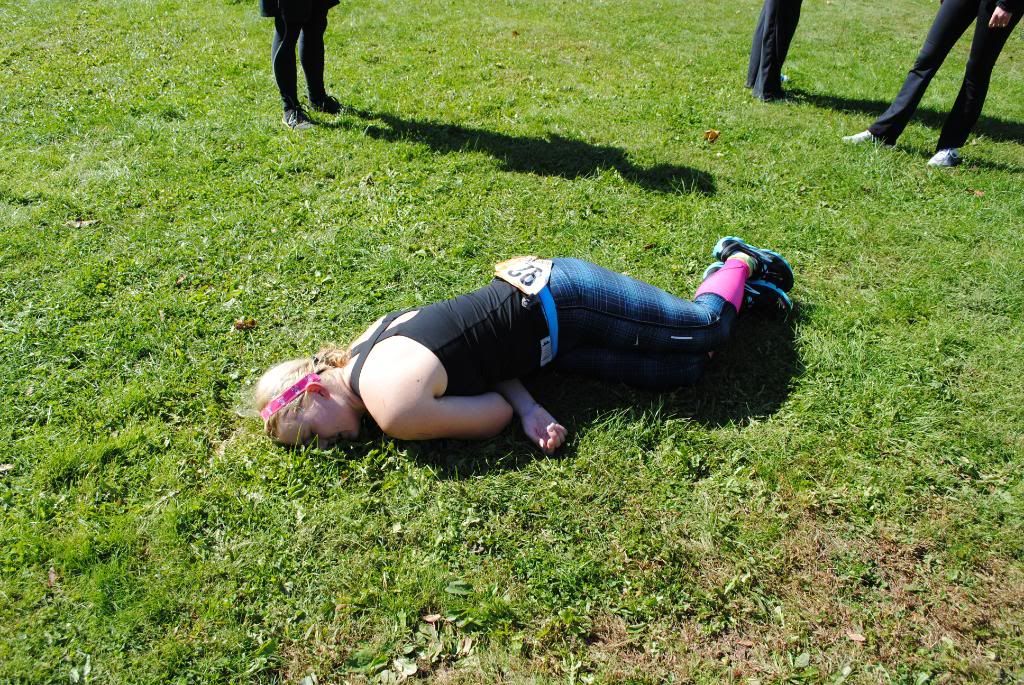

I've just been a terribly non responsive member of society lately. Aside from my day job, most emails have gone unsent, volunteer work has not been done, planning or writing or anything has been on hold.
Why?
I don't know. It's like I suddenly stopped caring. Perhaps I reached that edge where having a lot on my plate was suddenly not a motivator and instead, it was a paralyzing factor. Or maybe it's because I really enjoy training and after I train, all I want to do is sit on my butt and think about training/watch tv. Whatever the reason, if my begging off on my friend/volunteer/teammate/
So, now that I've put my big girl panties on, it's time to talk about a big event that is happening in 3 days:
My third marathon.
I chose the Flying Pig Marathon in Cincinnati because...I have no idea why (honestly). My recollection is that part of it was timing (late Spring marathon!), part of it was that Runner's World said it would be fun (if you love hills!), and partly because I had just spent too much time at the Marine Corps Marathon Expo when picking up my 10k bib.
This has been a really weird pre-race experience. It's all jumbled in my head, so let's try to break it down:
1) One is the Loneliest Number. This is the first time I'm doing a major race (read: marathon) without support crew. The first time, my mom, my then boyfriend, and Chadd were there. My second marathon, Katie and Chadd came out...but this time...it's me and the road.
I totally underestimated how awesome it is to have crew. During the RnR National Half, I saw Chadd at 6, accidentally saw Cyndi at 10, and my coach just after 12. And every time I got tired between those, I started to think about how I would see someone soon and that powered me on. This is not to discount the friends I'm going with (including Justin, Ayla, and Amanda - some of my Ragnar rocks). But these amazing friends will be running their own races.
I suddenly feel naked.
I've been told that this is a VERY friendly marathon. I think it may be one of the reasons I saw in the RW article. They apparently close the course down after the allotted time, but they continue to support runners after they've moved them to the sidewalks. Now THAT is friendly.
2) Holy Hills, Batman. So, in a moment of true intelligence, I didn't look at the course elevation profile prior to registering. And now that I've looked at it, I have the pre-race nervous pees. I'm amazing with rolling hills. Probably because of my spinning, I'm totally cool with glorious rolling hills. May go towards explaining why I loved the RnR National Half course. What I do not particularly love is a 3+ mile incline. This gives me flashbacks to Ragnar PA where I had 10+ miles up Mt. Pocono. There is actually a photo of me somewhere slumped on the ground, considering death after that.

Ah. There they are.
Y'all. My COACH had a temper tantrum in 2010 when she did this race. Granted, she also placed second in her age group...but, yikes. The positive to this is that my coach knows this race and has been able to give me a lot of insight into it. We've agreed that I shouldn't go out trying to bank time in the first half. Instead, I'm going to hold a 9:30 for the first half, check my watch at the 10k, the half, the 18 and the 22. The back half of the race is my strong suit - again, cue rolling hills.
3) As in...Sub-4. This may have been the wrong race to try and have such a strong PR. But I WANT that sub 4. I mean, that's the real reason I'm running another marathon (or that's my publicly facing reason, I could keep a shrink in business forever if we went into my addiction to endurance sports).
I keep telling myself that the last marathon I did, I did not run a smart race. I ran without regard for strategy. I got a late start in the wrong corral, I fought my way back to my group and was totally spent by 20.
4) Bigger, Better, Faster, Stronger. It's weird to have a marathon simultaneously be a non-event and cause me anguish. I've been impressively nonchalant about it in the past months. Mostly because I spend all of my anxiety time thinking about the 70.3 in August. Maybe it's also because I've distracted myself with unemployment, two job changes, and a bunch of other stuff. It's not like worrying MORE about a marathon makes it easier. It's not like this is a part of training, but in the back of my mind I feel like I'm behind on worrying. It's almost like I haven't gotten over my worry process and now I'm not going to be prepared.
In reality, I should be confident. I haven't been worried because I have this awesome thing called a coach. Coach T has taken all the pressure off of me because all I have to do is what she says. And I've done just that. I haven't been sore after any of my runs. I have comfortably held 9:30's and below on all my training runs. I need a steady 9:07 to pull this out of the bag, which means I trained at the right pace and I should be able to pull out a sub 4. I will run a smart race because I was smart when I was training.
5) The Future. Unlike the last two times I've trained, I haven't gotten sick of training. Sure, I wasn't stoked about going out for 18 miles, but it's not been the same imposition as it's been in the past. I've actually enjoyed it. I'll credit my coach with a big part of this. I've already started thinking about marathons for the fall if I don't hit sub-4 (and let's be honest...even if I DO hit sub 4...). So, unlike the last times where I've had goals (a time goal AND a goal to never do a marathon again if I made my goal), this time I just have one goal: sub 4. And if I don't make it, I just have to try again.
So, in just 3 days time, you will see a very brief post. It will hold the results and probably another marathon goal - sub-4 or not.
Let me know if you'll be in Cincinnati! I'd love to say hi!
Subscribe to:
Posts (Atom)